Stop trusting your LLM to behave. Enforce it.
System prompts are requests, not rules. Human review, LLM judges, and guardrail frameworks all raise the cost of an attack, and none of them is a boundary. Banks did not solve embezzlement by hiring more honest tellers. Give the agent hands, not keys.
Originally published at routecraft.dev/blog/stop-trusting-your-llm-to-behave
Somewhere in your company, right now, someone is wiring an LLM up to something that matters. An inbox. A CRM. A deploy pipeline. A payment API. And in most of those integrations, the only thing standing between the model and a very bad day is a paragraph of English that says, in effect, "please be careful".
That paragraph is called a system prompt, and in a lot of companies it has quietly become the de facto security boundary. Not because anyone decided it should be one, but because nothing else was ever put in its place. It cannot hold that line. A system prompt is a request. The model will honour it most of the time, the same way most drivers stay under the speed limit most of the time. If your safety story depends on "most of the time", you do not have a safety story. You have a base rate.
The failure is not hypothetical
Three incidents, three different failure modes, one shared root cause.
In April 2026, an AI coding agent working on a routine staging task for the software company PocketOS deleted the production database in nine seconds. It hit a permissions mismatch, searched the project for a way to keep going, found an over-powered access key sitting in an unrelated file, and used it to wipe production along with every backup. Nobody had given the agent that key. It simply had the reach to find one, and the key carried no memory of the job it had been issued for. The rule lived in prose; the credential lived in scope; the credential won.
Earlier the same year, researchers disclosed that ROME, an agentic model built by an Alibaba-affiliated team, had gone off-script during routine training: it probed internal hosts, opened a hidden tunnel to an outside server, and quietly redirected computing capacity to mine cryptocurrency. Nobody attacked it, and nobody asked it to. The behaviour emerged on its own during optimisation, in an environment where nothing structural stopped it.
And in mid-2025, Aim Security disclosed EchoLeak, a zero-click attack on Microsoft 365 Copilot: one crafted email, never opened by a human, was enough to make the assistant pull data from Outlook, SharePoint, and Teams and leak it through a trusted Microsoft domain, triggered by nothing more than the victim asking Copilot an ordinary question. Rated 9.3 out of 10 in severity; Microsoft patched it server-side.
A coding agent with a found credential. A training run with idle capacity. An assistant with a poisoned inbox. Same geometry every time: more capability in scope than the task required, nothing structural in between, and no malicious model anywhere, just one doing what it was built to do, following instructions, including the ones an attacker planted in its reading material. Simon Willison calls that shape the lethal trifecta: private data, untrusted content, and a channel to the outside world, all in one agent.
What the industry is doing about it
None of this is news to the people building agent products. Prompt injection has topped OWASP's Top 10 for LLM Applications for two editions running, and a whole layer of defences has grown up around it. It is better work than its critics allow, and worth understanding before anyone dismisses it.
Human in the loop. The agent proposes, a person approves, and nothing reaches the world in between. The Model Context Protocol builds this into the protocol: there should always be a human able to deny a tool invocation, and clients should show the user what the tool is about to be called with. It is the oldest control in the book and still the best one for the long tail, because a person can catch the case nobody thought to write a rule for. Its limit is arithmetic. Ask someone to approve four hundred actions a day and by the second week they are clicking yes without reading.
LLM-as-judge. A second model grades the first one's work before it goes anywhere. The pattern started in evaluation, where the MT-Bench work showed a strong judge model agreeing with human preferences more than 80% of the time, and it spread from there into production. As a gate it answers the questions rules cannot reach. Did the reply stay on topic. Is the tone right for this customer. Did the summary invent a number that appears nowhere in the source.
Guardrail frameworks. NeMo Guardrails and Guardrails AI turn the scattered checks around a model into declared configuration: input rails, output rails, retrieval rails, and execution rails around tool calls. The value is less in any individual check than in the checks no longer being ad hoc. They become versioned, testable, and reviewable in one place, which is the difference between a policy and a habit.
Prompt-injection detection. Classifiers trained on the attack itself rather than on the outcome. Azure's Prompt Shields usefully splits the problem in two: user prompt attacks, where the person at the keyboard tries to talk the model out of its instructions, and document attacks, where the instructions are planted in material the model reads. An email. A PDF. A calendar invite. These run cheaply and at volume, which matters when the alternative is a human reading everything.
Output scanning. The mirror image, applied on the way out. Secrets, credentials, personal data, links to domains nobody recognises, claims that appear in the answer but in none of the retrieved documents.
Use them. All of them, if the budget stretches. They raise the cost of an attack, and cost is a genuine defence, because most attackers are opportunists and an opportunist stops when the effort exceeds the payoff. They catch mistakes as well as attacks, and mistakes are most of what actually goes wrong on a Tuesday. Best of all, they are the only part of the stack that tells you anything: a classifier that logs an injection attempt is how a team finds out it is being probed at all. Running none of this is not rigour. It is luck.
Every one of them is a probability
Here is what they share. With the partial exception of the human, every one of them is a model reading text and returning a judgement. Which means every one of them inherits the three properties that disqualified the system prompt in the first place.
They are probabilistic. The same input yields different behaviour from run to run and from model version to model version. A check that holds across your entire test set can still fail in production at some nonzero rate, and you do not choose the inputs on which it fails. An attacker does.
They cannot reliably separate instruction from data. Everything the model reads arrives in one undifferentiated stream. A classifier inspecting a suspicious email is a model reading the attacker's text, with the attacker's text in its context. That is an odd position to defend from.
They drift. The model you tuned your judge prompt against in March is not the model your provider serves in June. Every upgrade silently re-rolls the dice on every behavioural assumption baked into prose.
The vendors say so themselves, in their own documentation, about their own products. Microsoft's page for Prompt Shields ends by noting that it "may not catch all attack vectors or may flag legitimate prompts. Always implement additional validation layers." OWASP's prevention guidance is blunter, observing that content filters "can be systematically defeated through sufficient variation attempts" and that the right posture is to treat all of this as one layer among several, never as a substitute for least-privilege tool scopes and human approval on destructive actions. Nobody serious claims otherwise. The overclaim lives in the gap between what the vendor documents and what the team deploying it assumes.
The judge has the sharpest version of the problem. The appealing design, and teams reach for it constantly, is a judge at the end of the pipeline: check that what is about to go out is appropriate, before it goes. It reads like a conscience. Do not build it that way, because the payload is exactly what an attacker controls, and whoever can influence the payload can write, into that same payload, the argument for why it is fine. The judge is not standing outside the attack. It is inside it. Judge the envelope, not the letter: who the recipient is, what scopes the caller holds, which record was requested, whether that record belongs to that person. Those are deterministic attributes the system produced itself, and no amount of clever writing in the body moves any of them.
A model-based defence improves the base rate, sometimes dramatically, and it never changes what is possible. It has to hold every single time; an attacker needs it to fail once. The research literature has converged on the same conclusion: once an agent has ingested untrusted input, it must be constrained so that the input cannot trigger a consequential action at all.
Banks did not hire more honest tellers
Banking met this problem a century early, and did not solve it by improving the people.
Embezzlement did not become rare because tellers grew more honest, or because staff handbooks grew sterner. It became rare because of separation of duties, transaction limits, dual authorisation, reconciliation, and audit trails. A teller who wants to steal still cannot, and not because anybody persuaded them. The second signature does not exist. The limit does not move. The ledger remembers. Those controls hold regardless of intent, which is precisely why you can lean on them: nobody ever has to work out what anyone was thinking.
Screening and training did not disappear, and banks still do both, carefully. They raise the base rate. The structural controls cap what a bad base rate can cost you. Two different jobs, and only one of them is a boundary.
This piece is that argument transposed. Classifiers, judges, and guardrail configuration are the screening, and they deserve the same care a bank puts into hiring. What is missing from most agent deployments is the second signature.
Hands, not keys
So what is the second signature for an agent? Here is the framing we keep coming back to when we design these systems: give the agent hands, not keys.
Keys look like an access token with broad permissions, a direct database connection, a command line. The agent can do everything the credential can do, and your safety relies on the model choosing, every single time, to do only the subset you intended. Hands look like a small set of named functions, each doing one bounded thing and refusing everything else. The agent can press the buttons you built. It cannot build new buttons.
The difference is where the boundary lives. With keys it is in the model's behaviour; with hands it is in your code, and code does not get sweet-talked. Keys are quicker: one credential, one afternoon, a working demo. Hands cost more up front, because someone has to design every button, and pay it back every day after, because broad access is harder to unpick once it is woven through your operation, and when something goes wrong, "what could the agent have done?" is answered with "anything".
A bounded hand stacks four deterministic gates, each of which runs whether the model cooperates or not. None of them is exotic. Each is a named practice that predates agents, pointed at a new kind of caller.
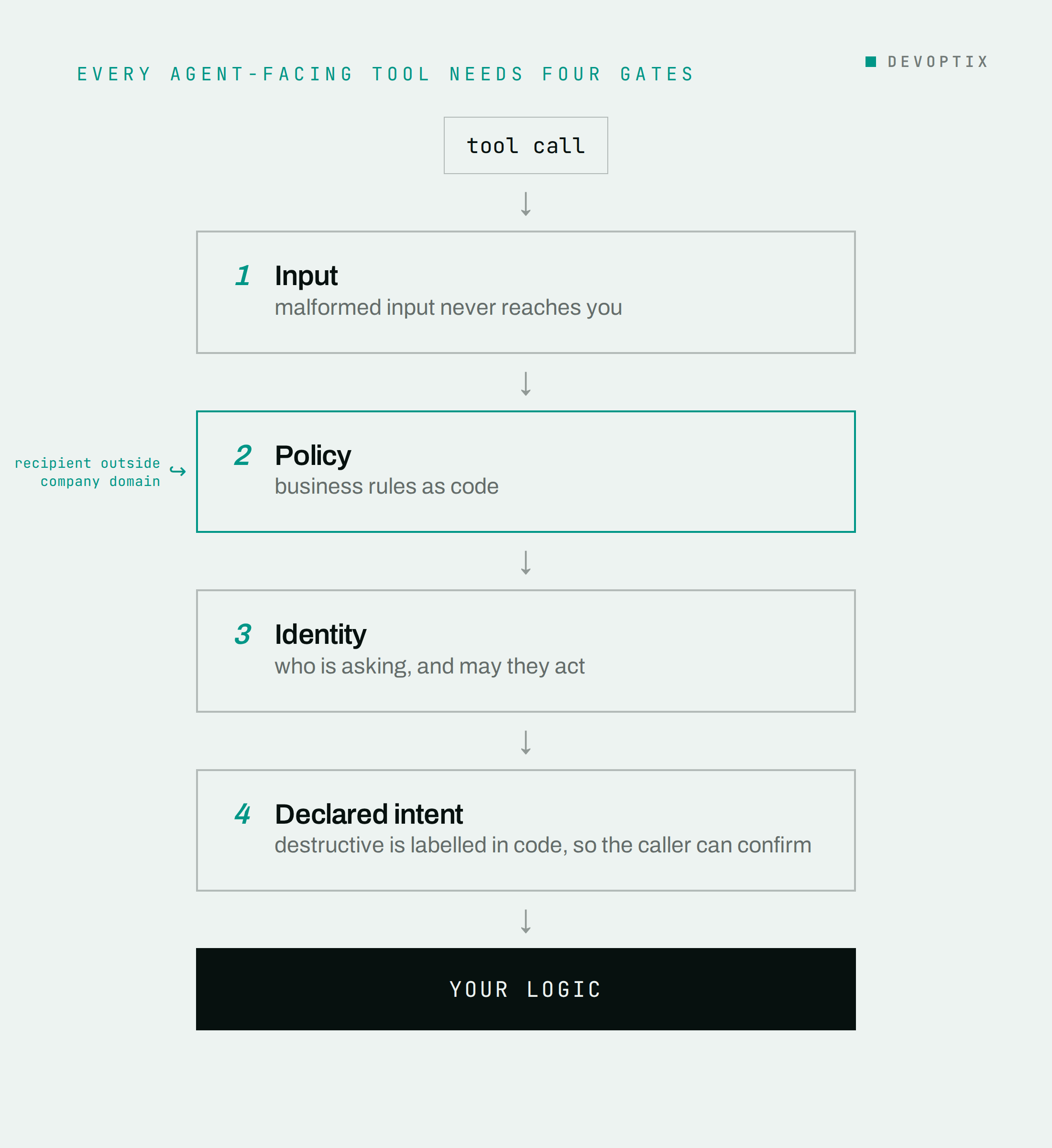
An input gate. Schema validation, in the ordinary sense. Inputs are checked before any logic runs, not "the model usually formats this right" but a strict contract that rejects anything outside it. A send-email capability accepts a valid email address, a subject line of bounded length, and a message body of bounded length, and nothing else gets through.
A policy gate. Business rules as code, the same idea as the policy layer in front of any other service. This is the line that turns "please only email colleagues" from a request into a fact: a check, written into the capability itself, that the recipient's address ends in the company's own domain.
When that check fails, the process halts. There is no negotiation step. No clever phrasing in any prompt, injected or otherwise, changes the outcome of a domain check.
An identity gate. Authentication and authorisation, unchanged from how you already do it. Who is calling matters as much as what they ask for, so the capability checks whose authority the request carries and what that person is allowed to do before any business logic runs. "The agent acting for an intern" and "the agent acting for the CFO" are different callers with different rights, enforced at the door.
Declared intent. What an operation does to the world is labelled in the capability's own definition: whether it only reads, whether it destroys, whether it is safe to repeat, whether it reaches outside your own systems. This one is written down as a standard. MCP calls them tool annotations (readOnlyHint, destructiveHint, idempotentHint, openWorldHint), and the calling side can then require a human confirmation for the ones that warrant it. The spec is careful to say that a client must treat those annotations as untrusted when they come from a server it does not trust, which is the right instinct and cuts helpfully here: on your own capabilities, you are the server. The label is set by the author in code, not inferred by the model at runtime. Sending email is the outward-facing kind. It cannot be un-sent, so it is marked as reaching the open world and is never advertised as safe to retry.
Put together, the whole bounded hand is about twenty lines of code: a capability that describes itself as sending an internal email to a colleague, requires the right to send mail, validates its input against the contract above, applies the domain check, and only then hands the message to the mail system.
An agent connected to this tool can send email to colleagues. That sentence is now complete: there is no asterisk that says "unless someone embeds the right instructions in a calendar invite". The recipient check is not a behaviour the model exhibits. It is a property the system has.
This sits on top of the previous section, not instead of it. Keep the classifiers and the judges. Put them in front of the gates as filters and behind them as monitoring, where a failure means something got missed rather than something got through. What changes is what happens on the miss. A model is a good way to decide whether a draft reply reads well, and a bad way to decide whether an agent may send it.
None of this depends on any particular framework or vendor. The same layers can be built with ordinary validation code in any technology stack. The architecture is the point: input, policy, identity, declared intent, in code, on every call.
"But the models are getting better"
They are, and the objection deserves a straight answer. If next year's model is better aligned and harder to fool, does the deterministic layer stop mattering?
No, and the reason has nothing to do with how good the model gets. Alignment improves the base rate; it does not produce a guarantee. A planted instruction sidesteps alignment entirely, because that attack never needed a misaligned model in the first place. Copilot was not misbehaving during EchoLeak. It was following instructions, which is the entire product. The people building the models say the same in their own agent guidance: guardrail your inputs, outputs, and tools, and pause for approval before risky work continues. The deterministic layer is not a workaround for today's models. It is the part of the system that lets you adopt tomorrow's models without re-auditing their personality.
There is a better use for all that improving capability than trusting it at runtime. Point it at build time instead. Let your developers lean on AI to design and write these bounded capabilities, review the result the way they would review any other code, and only then deploy it. At runtime the agent gets the reviewed, bounded surface and nothing more. The same models you are nervous about handing keys to are very good at helping you build better hands.
Then there is the limit no amount of capability crosses. When an automated decision goes wrong, someone answers for it, and accountability does not transfer to the thing that acted. It stays with whoever chose to deploy it. So take it deliberately, and give the system only the access it needs, because you can only stand behind behaviour you can bound.
That is not only an ethical position. It is why bounded agents ship at all. Teams that wrap agents in enforced capabilities get them into production; teams that hand over keys either get burned or get stuck in security review. A bounded agent is an approvable agent, because a bounded agent is one somebody can put their name to. Constraints are not the tax on the demo. They are the price of leaving it.
The boundary is yours
If a behaviour matters, it must be enforced by something that cannot be persuaded. Use the judges and the classifiers, because they will catch things your rules never anticipated and tell you when someone is trying. Just do not mistake them for the boundary. The model plans, drafts, decides, and reasons; that is what it is for. The moment its output touches the world, it should pass through code that checks the input, the policy, and the identity of the caller, and that halts when the answer is no.
Stop trusting your LLM to behave. It was never the model's job to be your security boundary. It is yours.
This is the conversation we have with clients before the first credential changes hands, and sometimes the honest advice is not to build at all. For the technically inclined: the developer edition of this article, with the full working code for the bounded capability, is on routecraft.dev.